
See the posture. Fix the station.
Upload one work cycle. Ergomatic scores every moment with RULA, colours the body where it is under strain and shows the worst second. This is what you get with each job.
In short
- Watch the job with the score on it: the video and a rotatable 3D body, in sync.
- Every moment is scored. You get the grand score, the action level, the worst second and the time spent in each risk band.
- The body is coloured by risk, so you see which joint is driving the score, not only the number.
- Findings in plain language, and a report you can hand to engineering, your safety lead or an auditor.
- Film the task again after a change and compare. The drop in score is your proof.
Watch the job with the score on it
The player shows your original video with the operator’s body coloured by risk, next to a reconstructed 3D body. Both move together through the whole recording, and you can use either one on its own.
A side panel gives the RULA score for neck, shoulders, elbows, wrists, trunk and legs, left and right. The timeline is coloured by risk with the worst moments marked, so you can jump straight to the postures that matter.
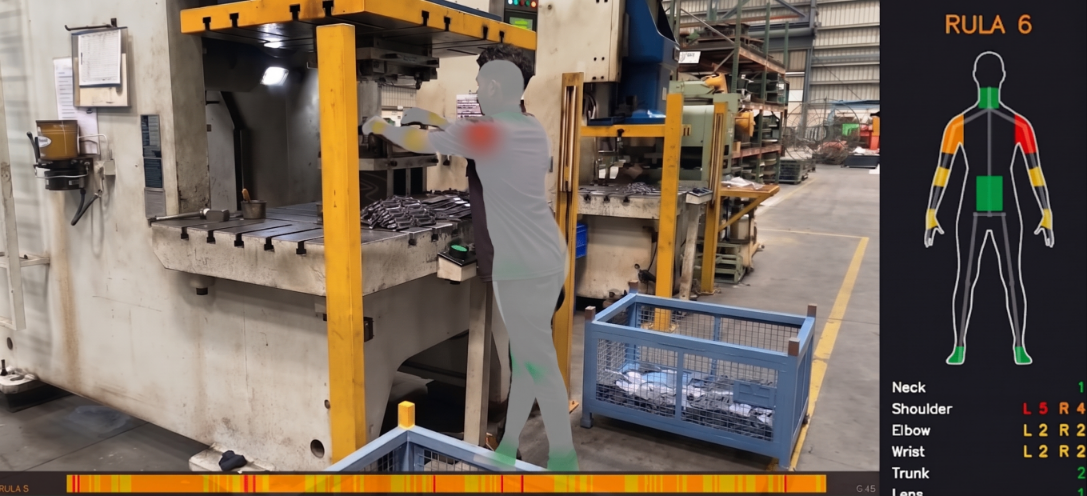
Turn the body and see what the camera hid
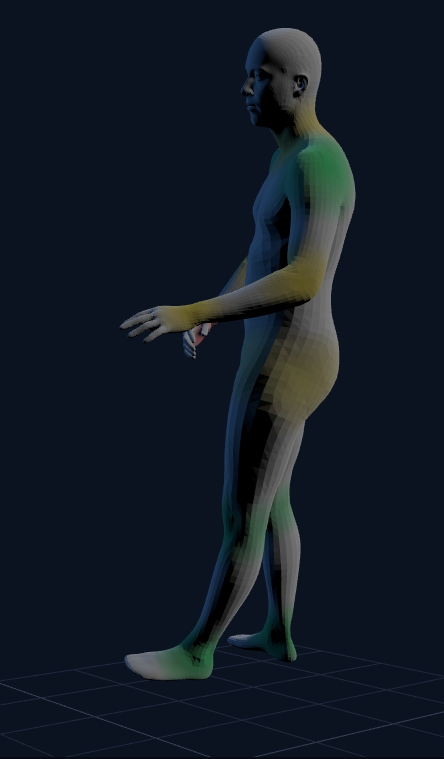
From the front, a twisted trunk or a raised elbow is easy to miss. Rotate the 3D body a full 360° and zoom in to check the posture from any side.
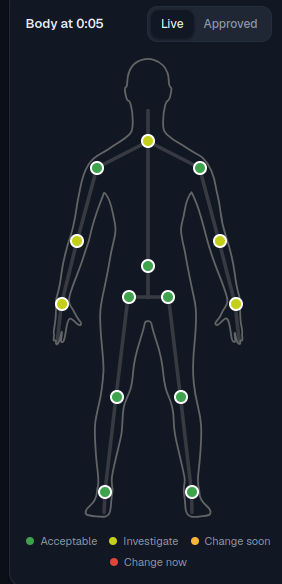
Colours run from green (acceptable) through yellow and orange to red (change now). Step through the video and watch which part of the body turns red, and when.
A score you can explain
Ergomatic measures joint angles and scores them with the published RULA method. Group A covers the upper arm, lower arm and wrist. Group B covers neck, trunk and legs. Muscle use and force are added. You get a grand score from 1 to 7 and one of four action levels.
The same rules run on every moment of every video. A line, a shift or a site is judged on the same yardstick, so you can compare jobs without arguing about who scored them.
Which joint, not only which number
A score tells you how urgent a job is. The body map tells you why. It colours the neck, shoulders, elbows, wrists, trunk and legs by action level for the second you are looking at.
That points the fix at the right place: a bin height, a fixture angle, a tool grip. You change the cause instead of guessing.
The whole cycle in one summary
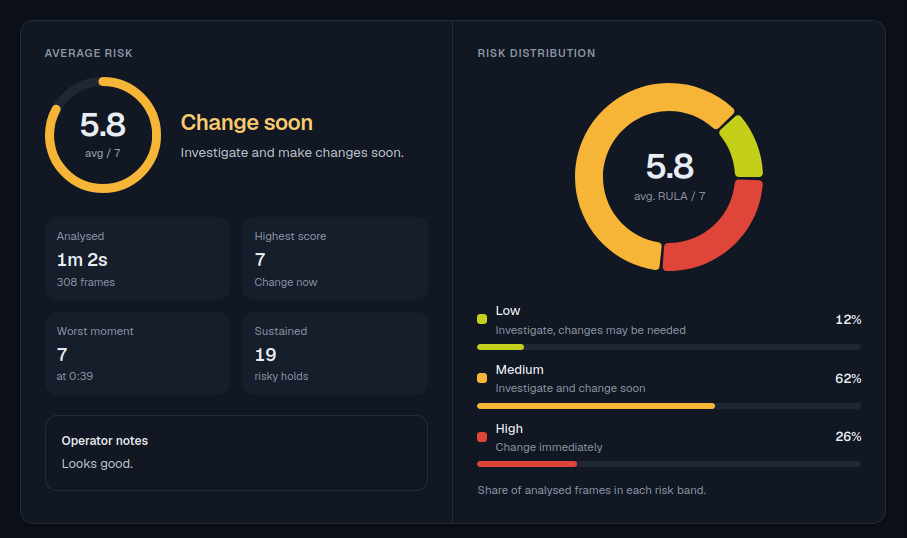
Each job ends with a summary: average score and action level, the highest score, the worst moment with its timestamp, the number of long risky holds and how much video was analysed.
The risk distribution shows the share of time in each band. It tells a job with one brief peak apart from one that stays high all cycle. You can add notes next to the results.
Findings anyone can read
Each assessment includes short observations that say what is happening in the task and why it scores that way. Operators, supervisors and engineers can follow them without knowing RULA, which makes it easier to agree on the change.
A report you can hand over
Turn an assessment into a report for EHS, engineering, leadership or an audit. It records the task, the score, the drivers and where to focus, so the decision can be traced later.
Prove the fix worked
After a change, film the task again and compare the new score with the old one. A job that moves from action level 3 to action level 1 is an easy case to make for the next investment, and an easy change to copy on other lines.
Built on a published method
Ergomatic automates RULA (McAtamney and Corlett, 1993), a widely used method for upper-limb and posture risk. It is a screening aid, not a diagnosis. For lifting or whole-body work, pair it with REBA or the NIOSH lifting equation. The method guide shows when to use which.
Related ergonomics tutorials
RULA vs REBA vs OWAS: Choosing the Right Ergonomic Assessment Tool
Compare the most widely used observational ergonomic assessment methods — RULA, REBA, OWAS, the NIOSH lifting equation, Strain Index and OCRA — and learn which to use for each manufacturing task.
Assessment methods · Intermediate7 min readRead →Building a Manufacturing Ergonomics Program: From Risk Assessment to Kaizen
A step-by-step framework for building a manufacturing ergonomics program: leadership, worker participation, risk screening, prioritization, ergonomic kaizen, KPIs and relevant ISO standards.
Ergonomics program · Advanced10 min readRead →Assembly Workstation Design: Work Height, Reach Zones and Layout
Design ergonomic assembly workstations: recommended work heights for precision, light and heavy work, primary and secondary reach zones, parts presentation and sit-stand options.
Workstation design · Beginner8 min readRead →Keep going
- What you get: the player, the 3D body, the report.
- How it works: from phone video to score, in four steps.
- RULA, automated: the method behind the score.
- RULA calculator: score one posture by hand, free.
- Industries: the jobs that usually score worst in your plant.
- Tutorials: practical guides for ergonomics teams.
Score your first job today.
Film one work cycle on a phone, upload it and read the result. Start with free credits, or talk to us first.