
RULA, scored the same way every time.
RULA turns posture into a score from 1 to 7. Ergomatic applies the published rules to every moment of your video, so each job is judged by the same method instead of one assessor’s snapshot.
In short
- RULA was published by McAtamney and Corlett in Applied Ergonomics (1993) as a quick screen for upper-limb disorder risk.
- Group A scores the upper arm, lower arm, wrist and wrist twist. Group B scores the neck, trunk and legs.
- Muscle use and force are added to each group, and Table C combines them into a grand score from 1 to 7.
- Automation measures every analysed frame the same way, so the worst posture is easy to find and jobs are easy to compare.
What RULA measures
RULA (Rapid Upper Limb Assessment) is an observational method for rating exposure to postural risk factors linked with work-related upper limb disorders. It is widely used in manufacturing for tasks where the upper body does most of the work: assembly, packing, inspection, machine tending, soldering and similar jobs.
Group A — arm and wrist
| Segment | Base score | Adjustments |
|---|---|---|
| Upper arm | 1–4 by flexion/extension angle | +1 shoulder raised, +1 arm abducted, −1 arm supported or person leaning |
| Lower arm | 1–2 by elbow angle | +1 working across the midline or out to the side |
| Wrist | 1–3 by flexion/extension | +1 wrist bent away from the midline (deviation) |
| Wrist twist | 1–2 | 1 mainly mid-range, 2 at or near end of range |
Table A combines these four scores into the Group A posture score.
Group B — neck, trunk and legs
| Segment | Base score | Adjustments |
|---|---|---|
| Neck | 1–4 by flexion (4 if in extension) | +1 twisted, +1 side-bent |
| Trunk | 1–4 by flexion | +1 twisted, +1 side-bent |
| Legs | 1–2 | 1 legs and feet well supported and balanced, 2 if not |
Table B combines these scores into the Group B posture score.
Muscle use and force/load
Each group then receives modifiers. Add 1 for muscle use if the posture is mainly static (held for longer than one minute) or repeated four or more times per minute. Add a force/load score from 0 to 3 depending on the load and whether it is intermittent, static, repeated or applied with shock.
The modified Group A and Group B scores are looked up in Table C to give the grand score.
The four action levels
| Grand score | Action level | Recommended response |
|---|---|---|
| 1–2 | Action level 1 | Acceptable posture if not maintained or repeated for long periods |
| 3–4 | Action level 2 | Investigate further; changes may be required |
| 5–6 | Action level 3 | Investigate further and change soon |
| 7 | Action level 4 | Investigate and implement change immediately |
By hand and by video
A paper worksheet depends on an observer choosing one posture and judging each angle by eye. Two trained assessors can reach different scores for the same job, and the worst posture may last one second.
Ergomatic measures joint angles from video and applies the RULA rules to every analysed frame. The score is consistent, you see where in the cycle the risk peaks and you can re-run the same assessment after a change. Camera position and blocked views still matter, so review the flagged moments and apply professional judgement.
Instead of one worksheet you get a body map. The neck, shoulders, elbows, wrists, trunk and legs are coloured by action level for each second of the video.
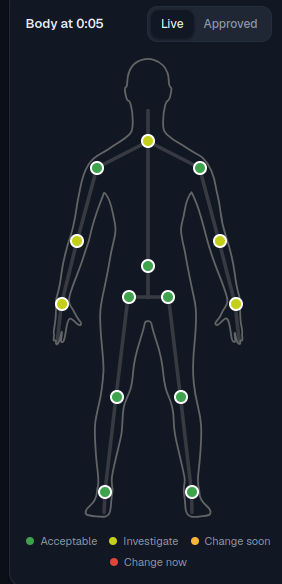
Want to score one posture by hand? Use the free RULA calculator, with Tables A, B and C built in.
When to use another method
RULA focuses on the upper limbs, neck and trunk. For whole-body postures with significant leg involvement, REBA is often a better fit; for lifting and lowering, use the revised NIOSH lifting equation; for pushing and pulling, use force-based guidelines. See our tutorials for a comparison of methods.
Related ergonomics tutorials
RULA Assessment Explained: A Step-by-Step Guide to Rapid Upper Limb Assessment
Learn how to score a RULA (Rapid Upper Limb Assessment) worksheet step by step — upper arm, lower arm, wrist, neck, trunk and legs — and how to interpret the 1–7 action levels on a manufacturing line.
Assessment methods · Beginner9 min readRead →RULA vs REBA vs OWAS: Choosing the Right Ergonomic Assessment Tool
Compare the most widely used observational ergonomic assessment methods — RULA, REBA, OWAS, the NIOSH lifting equation, Strain Index and OCRA — and learn which to use for each manufacturing task.
Assessment methods · Intermediate7 min readRead →How to Record Video for AI Ergonomic Assessment
Best practices for recording work tasks for AI pose estimation and automated RULA scoring: camera placement, framing, duration, lighting and worker privacy.
Video AI · Beginner5 min readRead →Keep going
- What you get: the player, the 3D body, the report.
- How it works: from phone video to score, in four steps.
- RULA, automated: the method behind the score.
- RULA calculator: score one posture by hand, free.
- Industries: the jobs that usually score worst in your plant.
- Tutorials: practical guides for ergonomics teams.
Score your first job today.
Film one work cycle on a phone, upload it and read the result. Start with free credits, or talk to us first.